according to the 4-5-12 rule, what is the following distance he must maintain?
EMS safety driving tips
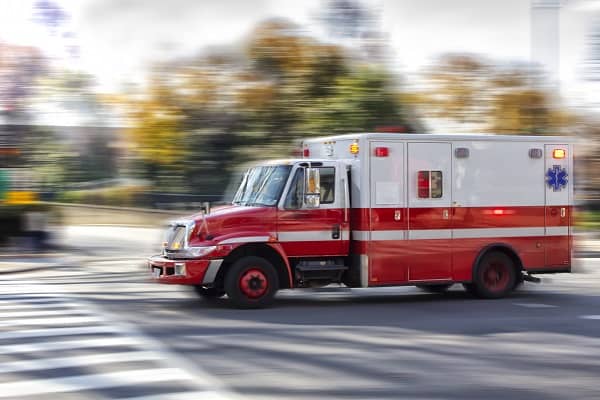 You might be thinking that with the EVOC, CEVO, Arrive Alive Do No Harm, in-house driver preparation, onboard monitoring, and pre-hiring approval of driving records that crashes in medical transportation would be decreasing. Unfortunately, that'southward non the example. Ems personnel are ii.five times more probable to dice in a crash than other workers. Roughly 70% of fatal crashes occur while running hot. Firefighters have a transportation fatality rate of five.7 per 100,000 personnel, law vi.1, but Ems practitioners lead at 9.6. When we look more closely we find that in fatal ambulance crashes the commuter of the ambulance comprised 4% of those killed, ambulance passengers 21%, occupants of other vehicles 63% and non-occupants 12%. Fortunately, only 1% of ambulance crashes involve fatalities. A common risk direction principle is that frequency is predictive of severity. Remember about it this way. The greater the number of driving errors we make that crusade collisions, even those with pocket-size or no damage and near-misses, the greater the likelihood that a fatal standoff will occur. Instead of dealing with emergency driving, we will accost other run a risk factors.
Distraction
When you're driving, driving is your master responsibility. Anything that takes your mind off driving (cerebral lark), your easily off the cycle (manual distraction) or your eyes off the road (visual lark) puts you at risk. It must be noted that hands' free cell telephone apply is just as unsafe equally manus held. Studies have shown that those using hands' gratuitous cellphones performed worse than drivers who were legally intoxicated. Reaching for a moving object (is your supersized soft drink tipping over?) increases the risk of crashing by a factor of 8.8 (that's times non a pct), drinking iv.1, eating i.6 and texting 23.2. Keep this in mind. Y'all need to exist paying attention to driving to be distracted from it.
Following altitude
A good number of crashes are caused by post-obit too closely. If the vehicle in front of you lot is smaller than the vehicle you are driving, it volition exist able to stop more quickly. To stop you must perceive the demand to stop, react to the perception and apply the brakes. At 30 mph you will travel about 174 feet earlier yous stop. One method to determine a safe following distance is the four second rule. At thirty mph y'all should be 4 seconds behind the vehicle in forepart of you. Pick a fixed object and notation when the vehicle in front of you passes information technology. Information technology should accept you four seconds to accomplish the object. For each 10 mph over 30 mph add one 2nd to the following altitude. Likewise add ane second each for pelting, snow, fog, sun-glare, and route weather condition. What if traffic conditions make the iv second rule impractical? Slow down. You are in a high-risk driving surround.
Backing
Bankroll is always dangerous. A paramedic was killed when struck past an ambulance in the headquarters' parking lot. Backing is always the result of preventable driver fault. Mirrors should be adapted at the commencement of shift and maintained throughout the day. Mirrors can be properly adapted only when the vehicle is direct. If you lot don't have a spotter, make up one's mind your line of travel by walking effectually the vehicle checking for obstructions and overhangs. Know the acme of your vehicle and look for signage. If it looks besides shut, it probably is. When bankroll plough towards the driver'southward side. Naturally, it is better to have a spotter to help the driver. The lookout should be 8-10 feet at the rear of the vehicle on the driver's side. The driver should stop if contact with the spotter is lost. It is surprising that some services do not accept compatible mitt signals. The EVOC curriculum has day and night versions of xi different hand signals. Manus signals should exist specified in policy and procedures, taught in orientation with documentation of proficiency, and monitored past supervisors for compliance.
Intersections
In addition to the risks encountered during emergency operations, intersections pose significant dangers in non-emergency circumstances. Uncontrolled intersections are usually in residential areas with low traffic density. Stop for pedestrians, vehicles already in the intersection and traffic to the correct. At intersections controlled past yield signs, slow down and stop as necessary for pedestrians and other vehicles. The unpredictability of the behaviors of other drivers at yield signs requires enhanced situational awareness. Make an cess of traffic in all directions before proceeding. Two-manner controlled and 4 fashion stop sign intersections require us to come to a consummate stop. Tapping the brakes and gliding through is not acceptable. Stop in front end of the limit line and proceed simply when it is safety and legal to practice and so. Traffic signals require special consideration. When stopped at a red calorie-free you should come across the rear tires of the vehicle in front of you to create an 8-10 foot absorber. A stale green light is one you didn't run into change from red to green and requires a cautious approach. In full general, yellow lights stay yellow for one second for every 10 miles per hour of the posted speed limit.
Make safety driving a addiction. A addiction consists of a cue, whatever prompts the beliefs, a routine, the behavior itself, and a reward, the payoff that trains our brains to repeat the habit in the hereafter. Not having minor crashes, which decreases of likelihood of getting killed or killing somebody else, is an adequate advantage.
References
- Kahn, CA, Ems, showtime responders and crash injury. Topics in Emergency Medicine 2006;26: 68-74
- American Integrated Training Systems, Emergency Vehicle Operator Grade, United states Section of Transportation, Springfield, Virginia(Date not specified in publication)
- BeckerLR, Zaloshnjaa E, et alia, relativerisk of injury and death in ambulances and other emergency vehicle. Scientific discipline Direct, 2003;35(6):941-948
- Szczygiel, Yard (Ed), EMS Safety, Jones & Bartlett Learning, Burlington, MA, 2017
This certificate is intended for general information purposes merely, and should not exist construed as advice or opinions on any specific facts or circumstances. The content of this document is made available on an "as is" footing, without warranty of whatsoever kind. This certificate can't be assumed to comprise every acceptable safety and compliance procedures or that additional procedures might not be appropriate under the circumstances. Markel does not guarantee that this information is or can be relied on for compliance with any law or regulation, balls confronting preventable losses, or freedom from legal liability. This publication is not intended to be legal, underwriting, or whatsoever other type of professional advice. Persons requiring advice should consult an independent adviser. Markel does not guarantee whatever particular outcome and makes no commitment to update whatsoever information herein, or remove any items that are no longer authentic or complete. Furthermore, Markel does non assume any liability to any person or arrangement for loss or damage acquired by or resulting from any reliance placed on that content. *Markel Specialty is a business concern division of Markel Service, Incorporated, the underwriting manager for the Markel affiliated insurance companies.
Was this helpful?
Source: https://www.markelinsurance.com/resources/medical-transportation/ems-safe-driving-tips
0 Response to "according to the 4-5-12 rule, what is the following distance he must maintain?"
Post a Comment